
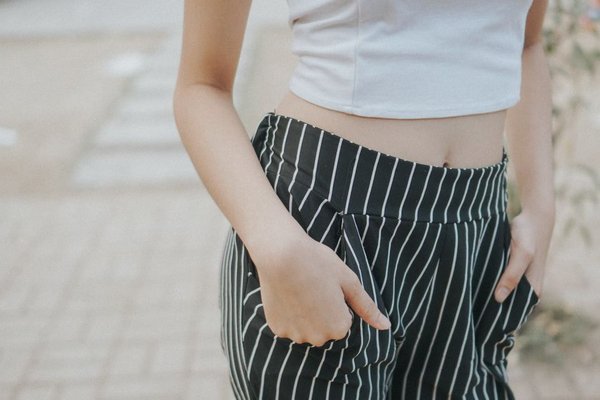
If your favourite high-waisted jeans seem to meet your ribs, or a cropped jumper looks shorter on you than it does on the model, you may have a short torso. That simply means the space between your shoulders and waist is relatively compact compared with your legs. It is a proportion, not a problem to fix. Still, understanding how to dress a short torso can help you create the visual balance you prefer without giving up comfortable clothes.
The trick is not to hide your waist. It is to make thoughtful choices about where a garment starts, ends and interrupts the eye. Small changes to trouser rises, neckline length and layering often make more difference than buying an entirely new wardrobe.
Find your natural proportions before changing your clothes
Stand in front of a mirror wearing a fitted top and trousers. Notice the distance between your underarm area, narrowest waist and hips. Does a waistband sit close to your bust, or does a standard cropped top barely reach it? These clues can be more useful than your height. Someone tall can have a short torso, while someone petite can have a relatively long one.
Experiment with mid-rise and lower-rise trousers
Very high waistbands bring the dividing line between torso and legs upwards. That can be lovely if you want to emphasise your legs, but it may make your upper body appear even shorter. A mid-rise often provides a useful middle ground: enough coverage to feel secure, with a little more visible length above the waistband.
Lower rise trousers can extend the apparent distance between your shoulders and hips, especially when paired with a longer top. You do not need an ultra-low 2000s cut. Even moving the waistband a few centimetres down can change the overall impression.
Test the rise while sitting, not just standing
Waistband height should work for your daily life. When trying jeans or tailored trousers, sit down, bend and walk. If a lower rise gaps at the back or feels restrictive, it is not the right solution. A comfortable mid-rise with a well-chosen top may create better vertical proportions than trousers you constantly adjust.
Choose necklines that create space above the waist
A neckline changes how much uninterrupted visual space appears between your face and waistband. V-necks, open shirt collars, gentle scoop necks and unbuttoned cardigans draw the eye downwards. They can make the chest area feel less crowded, particularly when the waistband is already quite high.
There is no need to wear a deep neckline. A modest V or a shirt with its top button open can achieve a similar effect. Pay attention to neckline length relative to the garment: a wide, high crew neck combined with a very cropped, boxy top may visually compress the upper body, while an open collar on the same-length top can soften that effect.
Let your tops finish below the waistband
Cropped tops are often styled with high-waisted bottoms, creating a strong horizontal break just under the ribs. For short torso outfits that visually lengthen the upper body, try a top that falls over the waistband and finishes around the upper hip instead.
A straight-cut T-shirt, fine-knit jumper or softly fitted blouse can offer this extra length without becoming oversized. Check the hem in relation to your hips: if it ends at the widest point and feels bulky, try a slightly shorter version or a lighter fabric that drapes rather than stands away from the body.
Use tucks strategically
A full, tight tuck shows the exact waistband line and can make a high rise more prominent. A loose front tuck, a partial side tuck or leaving the top untucked may produce a gentler transition. Try each approach in the same outfit and take a photograph from the same distance. You will quickly see which feels right.
Build a longer vertical line with layers
An open blazer, long cardigan or unbuttoned overshirt creates two vertical edges running down your front. This encourages the eye to travel through the torso rather than stopping at the waistband. Choose a layer that falls below the waist, but make sure its shoulders and sleeves fit properly.
For example, combine a hip-length white T-shirt, mid-rise straight jeans and an open navy blazer. The T-shirt covers the waistband slightly, while the blazer frames the centre of the outfit. This is an easy UK smart-casual combination for an office day or weekend lunch.
Look at waist placement on dresses and jumpsuits
Dresses with a strongly raised or empire waist can make the section below the bust look longer and the torso above it look shorter. If that is not your preferred effect, compare styles with an adjustable tie, a less defined waist seam or a gentle drop at the hip.
For shirt dresses, moving a tie belt slightly below your natural waist can suggest extra torso length, provided the fabric still hangs neatly. On jumpsuits, pay particular attention to body length when sitting. A garment that pulls at the shoulders or crotch is a fit issue, not something clever styling should have to disguise.
Make the most of clothes you already own
Subtle colour choices can help too. Related shades across a top and outer layer create an uninterrupted centre, while a contrasting belt highlights the precise waistline. If you are building a capsule wardrobe, look for an outfit proportion guide and a guide to choosing trouser rises for more combinations to test. Comparing these with a guide to dressing a long torso helps explain why opposite approaches can work.
Common questions about dressing a short torso
Should I avoid high-waisted jeans?
No. High-waisted jeans can be flattering and comfortable, especially if you like their leg-lengthening effect. If you want more visible torso length, try a mid-rise pair or wear a longer top over the waistband instead.
Can I wear cropped jackets with a short torso?
Absolutely. A cropped jacket creates a higher horizontal break, so you might pair it with a longer inner top or lower-rise trousers. If you prefer a continuous vertical line, an open hip-length jacket offers a different effect.
Are belts a bad idea for a short torso?
Not at all. A contrasting, wide belt highlights the waist strongly; a narrower belt in a similar colour to your trousers is subtler. Try varying its position within the garment’s intended fit, without forcing it unnaturally low.
Does being petite mean I have a short torso?
No. Petite sizing generally relates to overall height, while torso length describes proportions within your body. Look at where tops, waist seams and rises actually sit rather than relying on a height label alone.
Choose balance that feels like you
The best approach to dressing a short torso is to notice the points where an outfit visually divides your body. Experiment with a slightly lower waistband, a more open neckline, a longer top or an unfastened layer, then keep the combinations you enjoy. You do not need every garment to lengthen your torso. Good style is a set of choices that support your comfort, taste and everyday life.